Youth strength training is the age-appropriate development of strength, coordination, and resilience in kids and teens, using bodyweight, bands, and free weights with the right progressions. It matters right now because youth sports are more competitive, have longer-seasons, and are unfortunately more specialized than ever. And if you’re a parent or coach, you’re probably trying to balance big goals with real-life concerns: athletes staying healthy, improving performance, building confidence, and keeping things sustainable for your athlete(s).
If you’re a parent wondering, “Is this safe for my 11-year-old?” or a coach trying to run two 30-minute sessions per week without turning it into chaos, this guide is built to be practical, not just theoretical.
What “Youth Strength Training” Really Means
Youth strength training is a structured way to build strength and athleticism in children and adolescents using safe exercises, appropriate loading, and supervision that matches their maturity and skill level. It’s not “mini adult bodybuilding,” and it’s not maxing out. It’s teaching good technique, body control, and progressive overload as athletes begin to build basic skills.
Simple examples:
- A 9-year-old learning how to squat by performing the exercise with bodyweight onto a box. This regression will allow the athlete to learn to load their hips properly, set their back, and push their knees out safely before adding load.
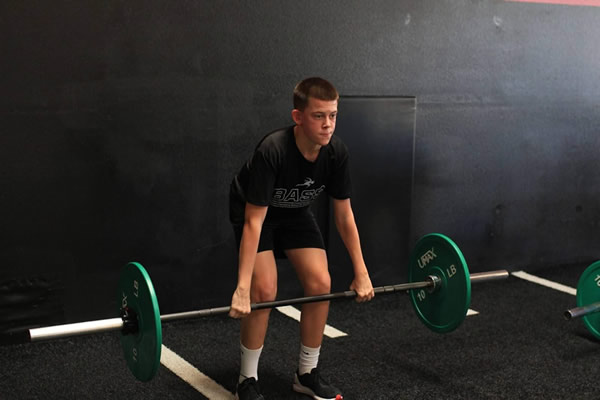
- A 15-year-old learning how to hinge (deadlift pattern) by first learning how to set their back correctly via the cat-cow exercise. Then lifting a barbell from the floor at knee height with light weight in order to safely practice lifting weight off the ground with a flat back.
Core Components
- Movement skill first: squat, hinge, push, pull, carry, brace, rotate or anti-rotate
- Progressive overload: a small, planned increase in difficulty over time (load, reps, range of motion, tempo, complexity)
- Supervision + standards: clear technique rules, stopping before form breaks, appropriate ratios
- Balanced athletic development: strength plus jumping and landing mechanics, sprint basics, and mobility where needed
Who Uses Youth Strength Training
- Parents supporting their kids staying healthy and building confidence
- Youth sport coaches building performance and reducing injuries
- Athletic trainers and clinicians guiding return-to-sport and safe progressions
- Youth athletes who want to get stronger without getting hurt
Why Youth Strength Training Is Growing Now
There’s more awareness around the relationship between strength training and injury prevention, and a bigger shift toward long-term athletic development. For a lot of families, “just play more” doesn’t feel like the full answer anymore, especially when kids are specializing earlier, practicing more, and dealing with more wear-and-tear. Parents also want training that supports health (sleep, confidence, and nutrition habits) while still helping sport performance.
Relatable analogy: think of it like learning to drive. You don’t start on a racetrack at top speed. You start in a parking lot, learn control and rules, then gradually increase speed and complexity.
How Youth Strength Training Shows Up in the Real World
You’ll see youth strength training happening (or needing to happen) in very different environments. The best programs don’t force one “perfect” setup. They adapt to the setting and still hit the essentials:
- Youth sport clubs (soccer, basketball, baseball): short sessions before or after practice, often utilizing bands and built around movement quality
- School weight rooms and PE gyms: larger groups, limited racks and dumbbells, and the need for stations, simple cues, and clear class management
- Clinics + sports performance facilities: more individual attention, return-to-sport progressions, and targeted work during growth spurts or after injuries
- At home: bodyweight, bands, and dumbbells, especially for families who need convenience, privacy, or a confidence-building entry point
- Team in-season “microdosing”: 15 to 25 minute lifts designed to maintain strength and power without soreness or fatigue
If you want more coaching-style breakdowns on how strength work fits into broader youth athlete development, you can also browse these training and mindset guides on Bass Athletics:
https://bassathletics.com/insights/
Real-World Scenarios Where This Shows Up
- U10 soccer team, 2× per week, 30 minutes, minimal equipment
Problem: kids are fast but “wiggly” with poor landing and deceleration control.
Context: small gym space, a few bands and med balls, and short attention spans.
Solution hint: station-based sessions focused on squat, hinge, push, pull, carry plus simple jump-landing games and weekly progressions. - 14-year-old female basketball player right after a growth spurt
Problem: knees cave inward on landings and quick stops; parent hears “ACL risk” and panics.
Context: she’s taller, coordination feels off, and preseason intensity is rising.
Solution hint: a neuromuscular block that emphasizes deceleration, single-leg strength, hamstring & glute development, and landing cues, before adding aggressive plyos. - High school baseball team in-season: 2×20-minute microdosed lifts
Problem: players lose strength by mid-season or get sore when lifting “like it’s the offseason.”
Context: games, travel, and throwing volume.
Solution hint: two short total-body sessions with low volume, moderate intensity, and power primers (jumps or throws) paired with hinge, pull, and squat variations. Light assistance exercises for shoulder girdle - PE teacher with mixed 6th to 8th grade classes and limited equipment
Problem: maturity spread is huge; some kids can’t do a clean push-up, others can.
Context: class management and safety are the bottlenecks.
Solution hint: readiness-based grouping, clear movement standards, and station cards with progressions and regressions (wall push-up → incline → floor).
Mini Case Study
Imagine a middle school that starts an 8-week “Strong Basics” program for 6th to 8th graders because coaches notice sloppy landings and frequent minor strains during sport tryouts. The PE teacher and a local S&C coach agree on three non-negotiables: teach positions first, stop sets when technique breaks, and keep sessions short and repeatable.
They begin every class with a 6-minute warm-up focused on bracing, skips, and stick-landings, then rotate through four stations (squat pattern, hinge pattern, push and pull, carry and core). Around week 3, several students hit a growth-spurt phase and look less coordinated, so the program temporarily reduces jump complexity and increases controlled tempos on bodyweight patterns.
By week 8, most students have improved squat depth and control, can hinge without rounding, and report feeling more confident in sport practice because they “know what to do with their body.” The big win isn’t a number on a bar. It’s better movement, safer effort, and higher buy-in.
Benefits, Outcomes, and What to Expect
Here’s what most families and coaches can realistically expect when youth strength training is coached well and progressed appropriately:
- Better movement skill and coordination (squatting, hinging, bracing, landing) that carries into sport and PE
- Strength and power improvements when progression matches technique and maturity, not just age
- Reduced injury risk factors through neuromuscular training (especially landing, deceleration, and single-leg control)
- Health benefits like improved body composition habits, stronger bones, and better confidence around physical activity
- Improved sport performance tools: sprint mechanics, change of direction, jumping, and contact readiness
- More consistency and less soreness when in-season plans use microdosing and smart exercise selection
For more reading on integrating strength work with long-term youth athlete development, see these expert tips on student-athlete development:
https://bassathletics.com/insights/
Step-by-Step Breakdown You Won’t Find on Other Sites
- Determine readiness (not just age) with a 3-point check
Can the athlete follow 2-step instructions, show basic self-control in a group, and demonstrate a safe body position (neutral spine in a hip hinge, knees tracking reasonably in a squat)? If “no,” start with simpler movement games, short sets, and more coaching. Progress can still happen. You’re just choosing the right starting line. - Build each session from the same repeatable template
Use: (a) warm-up plus landing mechanics, (b) one to two main strength patterns, (c) accessories for balance or posture, (d) short finisher or game. Repetition builds mastery. Variety still matters, but it usually comes from small changes (stance, tempo, implements), not random exercise roulette. - Use “technical standards” to progress, not hype
Progress when the athlete can hit the same movement quality for all reps (no knee collapse, no back rounding, controlled tempo). Stop sets at technical failure (form breaks), not absolute exhaustion. If you need a loading guide, use simple RPE targets. Most youth work should feel like “I could do 2 to 4 more good reps” when learning. - Choose the right dose: start small, earn volume
For beginners, 2 to 3 days per week is plenty. Keep total work conservative, prioritize full-body training, and avoid turning every session into a test. A great youth program finishes with kids feeling proud and fresh, not wrecked. - Monitor growth-spurt weeks and adjust the rules
When coordination drops, reduce plyometric complexity (fewer high-amplitude jumps, more stick landings), use slower tempos, and emphasize unilateral control and trunk stability. This is also when coaching cues matter most. Short, consistent cues beat long lectures. - Retest simply every 4 to 6 weeks
Track: (a) movement quality (video of squat or landing), (b) repeatable strength (e.g., controlled goblet squat reps at a fixed load), (c) isometric holds (side plank quality), and (d) jump-landing consistency. Progress should look like better control first, then bigger outputs.
Common Mistakes, Myths, or Misunderstandings
- Myth: “Lifting stunts growth”
Why it happens: fear around growth plates and old-school misinformation.
Do instead: focus on supervised technique, gradual progression, and age-appropriate loading. Injuries are more tied to poor supervision, reckless loading, and sloppy environments than the concept of resistance training itself. - Mistake: Treating kids like small adults (copy-pasting adult programs)
Why it happens: coaches default to what they know.
Do instead: prioritize movement skill, shorter sessions, more coaching, and progression based on mastery, not maxes. - Mistake: Too much too soon (volume, intensity, or complexity)
Why it happens: enthusiasm and social-media influence.
Do instead: use conservative volumes, stop sets at technical failure, and keep jumps and plyos within the athlete’s landing skill. - Mistake: Ignoring growth spurts and sudden coordination changes
Why it happens: plans are written once and never adjusted.
Do instead: have a “circa-PHV rule set” ready. Simplify, slow down, reinforce basics, and rebuild confidence. - Mistake: Only training what’s fun or what looks impressive
Why it happens: buy-in is easier with flashy exercises.
Do instead: earn the fun stuff by owning the basics. Keep a small menu of staple patterns and rotate variations strategically. - Mistake: No way to scale for equipment limits
Why it happens: programs assume a full weight room.
Do instead: program in “tracks” (bodyweight or bands, DB or KB, school gym) so the same goals can be achieved anywhere.
FAQ
What age can kids start youth strength training?
Many kids can start as soon as they can follow instructions and demonstrate basic balance and control, often around early elementary ages with bodyweight, light implements, and close supervision. The key is readiness and coaching, not a magic birthday.
How many days per week should kids strength train?
A common starting point is 2 to 3 days per week, full-body. Sport schedule, sleep, and overall stress matter. More isn’t always better.
How heavy is safe for youth strength training?
Use loads the athlete can lift with consistent, repeatable technique for the planned reps, stopping when form breaks. For many youth, moderate effort (leaving a couple good reps “in the tank”) is a smart default while skill is developing.
Will strength training damage growth plates?
Appropriately coached, age-appropriate resistance training is widely supported as safe. The bigger risk is poorly supervised training, excessive loading, or chaotic environments, so standards and coaching matter.
What should we do during a growth spurt?
Expect temporary coordination changes. Reduce plyometric intensity and complexity, emphasize controlled tempos, reinforce single-leg and trunk control, and prioritize movement quality over chasing new loads.
Can kids strength train at home without weights?
Yes. Bodyweight, bands, and simple household items (used safely) can build strength and control, especially when you use tempo, pauses, range-of-motion progressions, and consistent weekly structure.
Is youth strength training okay during an in-season schedule?
Yes, and it can help maintain strength and reduce overuse issues when dosed correctly. “Microdosing” (short, low-soreness lifts) is often the most practical approach.
What are the best exercises to start with?
Start with patterns: squat, hinge, push, pull, carry, brace, plus landing mechanics. Then choose the simplest version the athlete can do beautifully and progress from there.